Top 10 Fraud Patterns in Bank Statements and How to Detect Them?
- May 15
- 4 min read

In a world full of quick service and instant results, scammers easily gain access to systems. Organisations have become more reliant on digital processes for business operations, which also increases risks, particularly in corporate areas such as vendor onboarding, loan approvals, and credit assessments.
Technology is not just for expediting your process but also for protecting your business from sophisticated fraud attempts. In almost every business, to know the customers, businesses ask for various documents. But forging documents has become a piece of cake for scammers.
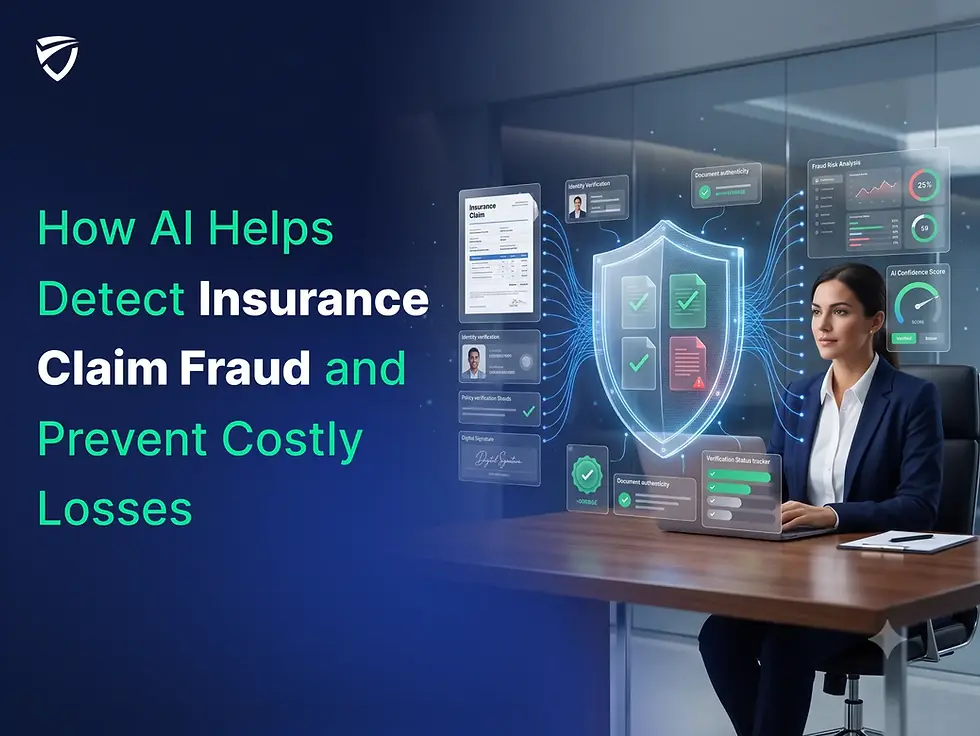
Bank statements are central to knowing your customer, yet manual checks struggle to distinguish genuine applicants from sophisticated scammers. Artificial intelligence changes this by automating and strengthening verification.
Cases of fake bank statement fraud have been registered not only in India over the past year but also worldwide, and the number of such cases is increasing daily. These fraud patterns are seen globally and pose significant risks to international corporate teams as well. Let us understand the patterns of these frauds and see how TrueShield.AI can help you secure your business from such scamsters.
What is the motive behind Bank Statement Fraud?
With traditional verification, a single fake document can easily slip into a stack of genuine ones, and a forged bank statement is often the fraudster’s first choice.
Fintechs and employers rely on bank statements to assess an applicant’s financial history.
When applicants inflate income or assets, it can lead to:
Overstated creditworthiness and inflated loan approvals
Unjustified hiring decisions or higher offers than warranted
Increased risk of loan defaults, salary overpayments, and operational losses
Similarly, when candidates switch jobs, some manipulate bank statements to show a higher salary, pushing companies to offer more than the candidate is truly worth. Individually, these may seem small, but over time they compound into a significant financial impact.
Worse, these are just the smaller, more common scams. Bank statement fraud can scale into far larger scams, exposing organisations to serious, often unexpected risk.
Today, with easily accessible editing tools, anyone can tamper with sensitive documents and insert whatever numbers or details they choose, making robust verification more critical than ever.
Here are the top 10 fraud patterns risk teams should watch for:
Transaction Amount Manipulation: Offenders edit transaction amounts, often inflating credits or deflating debits to show higher balances or incomes.
Date Tampering: Dates on statements are altered to hide or create transactions, misrepresenting financial activity during key assessment periods.
Page Addition or Removal: Extra pages are inserted, or authentic pages are deleted from statements to conceal negative financial activity or highlight false positives.
Fabricated Transactions: Complete fake transactions are added to simulate regular salary credits, business payments, or other positive cash flows.
Forged Bank Logos and Watermarks: Visual elements such as logos, watermarks, or bank-specific markings are forged to make fake statements look official.
Statement Reuse: Reusing the same statement for multiple applications with minor cosmetic changes, often across different organisations.
Account Number Substitution: Changing the account number on a valid statement to present false ownership or mask real account details.
Unusual Patterns in Transaction Narrations: Generic or typical narration fields that suggest manual editing or lack the usual detail from authentic statements.
Inconsistent Balances: Discrepancies between opening and closing balances or running totals that suggest manual edits without proper arithmetic alignment.
Use of Outdated Formats: Submitting statements using obsolete templates or formats not currently used by the stated bank, indicating possible forgery.
By looking out for such patterns, you get to know how to detect fraud in bank statements. TrueShield.AI can easily identify these patterns.
How can TrueShield.AI prevent scams?
AI uses pattern detection to determine whether the document is authentic. It also uses:
Typography consistency
Layer structures in PDFs
Transaction-to-balance mathematical continuity
OCR mismatches
Visual anomalies invisible to humans
To deliver this level of scrutiny at scale, TrueShield.AI combines these signals into a unified fraud-risk score for every statement. Instead of relying on a single red flag, the system correlates typography inconsistencies with anomalies in PDF layers, checks whether each transaction logically ties into the running balance, and cross-verifies OCR outputs against the underlying document content. This multi-layered approach helps uncover even well-disguised forgeries, such as subtle edits in amounts, dates, or account details. This may pass undetected in manual reviews, giving risk and credit teams a far more reliable foundation for decision-making.
Conclusion
In an era of increasing digital transactions, fraud is no longer a rare exception but a growing threat. Manual checks and basic bank statement verification are simply not enough to keep pace with sophisticated scamsters who exploit every gap in traditional processes. To truly protect your organisation, you need a smarter way to spot anomalies, validate authenticity, and uncover hidden risks.
An Advanced Bank Statement Analyzer like TrueShield.AI helps you do exactly that. By detecting bank reconciliation fraud, flagging tampered data, and validating every transaction against balances and formats, it transforms bank statements into a reliable foundation for decision-making. Instead of relying on intuition or time-consuming manual review, your team gains AI-driven insights that highlight suspicious behaviour before it turns into loss.
You can book a demo to get more information about TrueShield.AI and various ways to protect your business using this tool.


Comments